


Are compostable plastic forks resistant to heat?
Jul 25, 2025
Leave a message
As a supplier of compostable plastic forks, I often encounter various inquiries from customers. One of the most frequently asked questions is whether our compostable plastic forks are resistant to heat. In this blog post, I will delve into this topic, providing you with a comprehensive understanding of the heat resistance of our compostable plastic forks.
Understanding Compostable Plastic Forks
Compostable plastic forks are an eco - friendly alternative to traditional plastic forks. They are made from materials that can break down into natural substances under specific composting conditions. These materials are often derived from renewable resources such as corn starch, sugarcane, or other plant - based polymers.
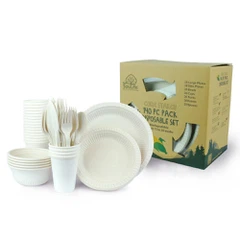
Our company offers a wide range of compostable plastic forks, including Takeaway Cutlery, Black Disposable Silverware, and Wrapped Disposable Silverware. Each product is designed to meet different customer needs, whether it's for take - out food, a formal event, or a more hygienic option.
Heat Resistance of Compostable Plastic Forks
The heat resistance of compostable plastic forks depends on several factors, including the type of material used in their production.
Material Composition
Most compostable plastic forks are made from polylactic acid (PLA), a biodegradable thermoplastic polyester derived from renewable resources. PLA has a relatively low glass - transition temperature (Tg), typically around 55 - 60°C (131 - 140°F). This means that when exposed to temperatures above this range, the plastic may start to soften and lose its shape.
However, some manufacturers, including our company, use additives and modifiers to improve the heat resistance of PLA - based compostable plastic forks. These additives can increase the glass - transition temperature, allowing the forks to withstand higher temperatures without significant deformation.
Testing and Certification
To ensure the quality and performance of our compostable plastic forks, we conduct rigorous heat - resistance tests. Our forks are tested in controlled environments to determine the maximum temperature they can withstand before showing signs of melting, warping, or losing their structural integrity.
We also adhere to international standards and certifications related to compostable products. For example, our products meet the requirements of ASTM D6400 (Standard Specification for Compostable Plastics) and EN 13432 (Requirements for Packaging Recoverable through Composting and Biodegradation). These standards not only ensure the compostability of our products but also provide guidelines on their performance under different conditions, including heat resistance.
Practical Applications and Limitations
In practical applications, our compostable plastic forks are suitable for a variety of food - serving scenarios. They can be used with warm foods, such as soups, stews, and hot cereals, as long as the food temperature is within the heat - resistance range of the forks.
However, it's important to note the limitations of our compostable plastic forks. They are not recommended for use with extremely hot foods, such as freshly - cooked deep - fried items or foods straight out of the oven. In such cases, the high temperatures can cause the forks to deform, which may affect the user experience and the overall functionality of the cutlery.
Comparison with Traditional Plastic Forks
When comparing the heat resistance of compostable plastic forks with traditional plastic forks, it's important to consider the trade - off between environmental impact and performance.
Traditional plastic forks, such as those made from polypropylene (PP) or polystyrene (PS), generally have higher heat - resistance properties. PP has a melting point of around 160 - 165°C (320 - 329°F), while PS has a melting point of around 240°C (464°F). This means that traditional plastic forks can withstand much higher temperatures without deforming.
However, traditional plastic forks are not biodegradable or compostable. They contribute to the global plastic pollution problem, as they can take hundreds of years to break down in the environment. In contrast, our compostable plastic forks offer an environmentally friendly alternative, even though they may have slightly lower heat - resistance capabilities.


Tips for Using Compostable Plastic Forks
To get the most out of our compostable plastic forks and ensure their proper use, here are some tips:
- Check the Food Temperature: Before using a compostable plastic fork, make sure the food temperature is within the recommended range. If the food is too hot, let it cool down for a few minutes before serving.
- Avoid Direct Heat Sources: Do not place compostable plastic forks directly on a hot surface, such as a stovetop or a hot plate. This can cause the forks to melt or warp.
- Proper Storage: Store compostable plastic forks in a cool, dry place away from direct sunlight. Exposure to high temperatures and sunlight during storage can also affect the heat - resistance properties of the forks over time.
Conclusion
In conclusion, our compostable plastic forks have a reasonable level of heat resistance, thanks to the use of advanced materials and manufacturing techniques. While they may not be suitable for extremely hot foods, they are a great option for a wide range of food - serving applications, offering an eco - friendly alternative to traditional plastic forks.
If you are interested in purchasing our compostable plastic forks, whether it's for your restaurant, catering business, or personal use, we invite you to contact us for a detailed discussion. We can provide you with samples, answer your questions, and help you find the best product to meet your needs. Let's work together to make a positive impact on the environment while still enjoying high - quality food - serving products.
References
- ASTM International. (2019). ASTM D6400 - 19: Standard Specification for Compostable Plastics.
- European Committee for Standardization. (2000). EN 13432:2000 - Packaging - Requirements for packaging recoverable through composting and biodegradation - Test scheme and evaluation criteria for the final acceptance of packaging.
- Lunt, J. (2008). Polylactic acid polymers. In Biopolymers, Volume 4: Polyesters II - Promising New Materials (pp. 1 - 43). Wiley - VCH Verlag GmbH & Co. KGaA.
Send Inquiry