


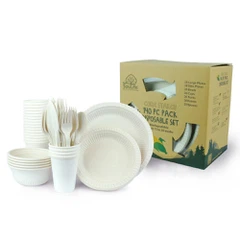
Are paper forks eco friendly?
Dec 04, 2025
Leave a message
In today's world, where environmental concerns are at the forefront of many discussions, the question of whether paper forks are eco - friendly is a crucial one. As a supplier of eco - friendly forks, I've delved deep into this topic to understand the true nature of paper forks and their impact on the environment.
Understanding the Basics of Paper Forks
Paper forks are typically made from paperboard or other paper - based materials. They are often used in settings where disposable cutlery is required, such as fast - food restaurants, take - out joints, and large events. The allure of paper forks lies in their perceived eco - friendliness. After all, paper is a natural material derived from trees, and it is biodegradable.
Biodegradability is a key factor when assessing the environmental impact of a product. Paper forks, under the right conditions, can break down into natural substances over time. Microorganisms in the soil or compost can decompose the paper, returning it to the earth. This is in contrast to traditional plastic forks, which can take hundreds of years to break down and often end up in landfills or as litter in the environment.
However, the production process of paper forks is not without its environmental drawbacks. The paper industry is known for its high water consumption. Trees need to be cut down to produce the raw material for paper, and the manufacturing process involves large amounts of water for pulping, bleaching, and other steps. Moreover, the chemicals used in the bleaching process can be harmful to the environment if not properly managed. Some paper forks may also be coated with a thin layer of plastic or wax to make them more resistant to moisture, which can reduce their biodegradability.
Comparing Paper Forks with Other Disposable Options
When considering the eco - friendliness of paper forks, it's important to compare them with other disposable cutlery options. One popular alternative is plastic forks. Plastic forks are made from petroleum - based products, which are non - renewable resources. As mentioned earlier, they have a very long decomposition time, and their improper disposal can lead to significant environmental problems, such as the pollution of oceans and harm to wildlife.
Another option is compostable forks made from materials like cornstarch or PLA (polylactic acid). These compostable forks are designed to break down in industrial composting facilities. They offer a more sustainable alternative to both paper and plastic forks. Compostable forks have a lower carbon footprint during production compared to paper forks, as they are often made from renewable resources.
For those interested in individual wrapped disposable cutlery sets, you can check out our Individual Wrapped Disposable Cutlery Set. It provides a convenient and hygienic option for various events and food service environments.


The Role of Certification and Standards
To truly determine the eco - friendliness of paper forks, it's essential to look at certifications and standards. There are several organizations that provide certifications for environmentally friendly products. For example, the Forest Stewardship Council (FSC) certification ensures that the paper used in the forks comes from sustainably managed forests. This means that the trees are harvested in a way that maintains the health of the forest ecosystem, protects wildlife habitats, and respects the rights of indigenous communities.
Another important certification is the compostability certification. Products with this certification meet specific criteria for breaking down in composting environments. If a paper fork has a compostability certification, it means that it can be safely added to a compost pile or sent to an industrial composting facility, where it will decompose within a reasonable time frame.
Real - World Impact of Paper Forks
In real - world scenarios, the environmental impact of paper forks can vary depending on how they are used and disposed of. If paper forks are used in a setting where proper composting facilities are available, they can be a relatively eco - friendly option. For example, at an outdoor festival with a well - organized composting system, paper forks can be collected and sent to a composting facility, where they will contribute to the creation of nutrient - rich soil.
However, in many cases, paper forks end up in landfills. In a landfill environment, the lack of oxygen and proper conditions for decomposition can slow down the breakdown process significantly. This means that even though paper forks are biodegradable in theory, they may not break down as quickly as expected in a landfill.
Our Offerings as an Eco - Friendly Forks Supplier
As an eco - friendly forks supplier, we are committed to providing products that have a minimal impact on the environment. We offer a range of Compostable Spoons and Forks that are made from sustainable materials. Our compostable forks are certified to meet high - quality environmental standards, ensuring that they can be safely composted in industrial facilities.
We also have a selection of Eco Friendly Disposable Cutlery that is designed to be both functional and environmentally responsible. Our products are suitable for a variety of applications, from small cafes to large - scale catering events.
Conclusion and Call to Action
In conclusion, the question of whether paper forks are eco - friendly is not a straightforward one. While they have some environmental benefits, such as biodegradability, their production process and real - world disposal can pose challenges. However, with proper management and the use of sustainable sourcing and production methods, paper forks can be part of a more sustainable solution for disposable cutlery.
If you are a restaurant owner, event planner, or anyone in need of eco - friendly disposable cutlery, we invite you to contact us for a procurement discussion. We can help you choose the right products for your specific needs and ensure that you are making an environmentally responsible choice.
References
- "The Paper Industry and the Environment" - Environmental Protection Agency
- "Composting 101: Understanding the Process" - Composting Council
- "Sustainable Forest Management" - Forest Stewardship Council
Send Inquiry