


Are there any certifications for disposable cpla cutlery?
Aug 12, 2025
Leave a message
Hey there! As a supplier of disposable CPLA cutlery, I often get asked, "Are there any certifications for disposable CPLA cutlery?" Well, let's dive right into this topic and find out.
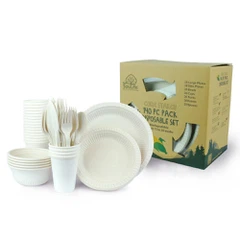
First off, let's talk a bit about what CPLA cutlery is. CPLA stands for Crystallized Poly Lactic Acid. It's a type of biodegradable plastic made from renewable resources like corn starch or sugarcane. This makes it a much more eco - friendly alternative to traditional plastic cutlery. Our company offers a great range of products, like Compostable Spoons and Forks, Eco Friendly Forks, and Individual Wrapped Disposable Cutlery Set.
Now, back to the certifications. There are indeed several important certifications for disposable CPLA cutlery, and they play a crucial role in the market.
One of the most well - known certifications is the ASTM D6400. This is an American standard. It sets the criteria for plastics that are considered compostable in industrial composting facilities. For a CPLA cutlery product to get the ASTM D6400 certification, it has to meet certain requirements. It must break down into carbon dioxide, water, and biomass within a specific time frame. Usually, it should degrade at least 90% within 180 days in an industrial composting environment. This certification is super important because it gives consumers and businesses confidence that the product they're using is truly compostable.
Another significant certification is the EN 13432. This is a European standard. Similar to the ASTM D6400, it also focuses on the compostability of products. Products with the EN 13432 certification have been tested to ensure that they can be composted in industrial composting plants. It has strict guidelines on the degradation rate, the quality of the resulting compost, and the absence of harmful substances. When you see this certification on our CPLA cutlery, you know it meets high - quality European standards.
There's also the BPI (Biodegradable Products Institute) certification in the United States. The BPI is a non - profit organization that verifies the compostability of products. To get the BPI certification, our CPLA cutlery has to pass a series of tests. These tests check if the product can break down in a composting environment and if it doesn't leave behind any toxic residues. This certification is widely recognized in the US market and is a mark of quality for compostable products.
Why are these certifications so important? Well, for one, they help us as suppliers. When our CPLA cutlery has these certifications, it shows that we're committed to producing high - quality, environmentally friendly products. It gives us a competitive edge in the market. Customers are more likely to choose our products over those without certifications because they know they're getting something that's truly compostable.
For consumers and businesses, these certifications are a guarantee. They can be sure that when they use our CPLA cutlery, they're making a sustainable choice. For example, restaurants that want to be more eco - friendly can use our certified cutlery to show their customers that they care about the environment. Event planners can also choose our certified products for their events, knowing that they won't end up in landfills for hundreds of years.
But getting these certifications isn't easy. We have to go through a rigorous testing process. Our products are sent to independent laboratories, where they're tested under specific conditions. The testing can take several months, and we have to pay for the testing fees. But we believe it's worth it because it ensures the quality and credibility of our products.
In addition to the compostability certifications, there are also food - contact safety certifications. For example, the FDA (Food and Drug Administration) in the United States has regulations for products that come into contact with food. Our CPLA cutlery has to meet these safety standards to ensure that it's safe for people to use when eating. This includes things like not leaching harmful chemicals into the food.
We also follow other international food - safety standards. For instance, in the European Union, there are strict regulations on food - contact materials. Our products have to comply with these regulations to be sold in the EU market. This means that we have to use high - quality raw materials and follow strict manufacturing processes to ensure the safety of our CPLA cutlery.
Now, let's talk about how these certifications impact our business. Having these certifications has opened up new markets for us. We can sell our products not only in the domestic market but also internationally. Many countries and regions have strict environmental regulations, and our certified products can meet those requirements.
It also helps us build trust with our customers. When they see the certifications on our products, they know that we're a reliable supplier. We've had customers who specifically look for certified CPLA cutlery, and they've been very satisfied with our products.
But we're not just resting on our laurels. We're constantly looking for ways to improve our products and meet even higher standards. We're researching new materials and manufacturing techniques to make our CPLA cutlery even more sustainable and of better quality.
If you're in the market for disposable CPLA cutlery, whether you're a restaurant owner, an event planner, or just someone who wants to make a more eco - friendly choice, we'd love to talk to you. Our certified CPLA cutlery offers a great combination of sustainability and functionality. We can provide you with high - quality products that meet your needs.
So, if you're interested in learning more about our products or have any questions about the certifications, don't hesitate to reach out. We're here to help you make the best choice for your business or personal use.
References:


- ASTM International. (n.d.). ASTM D6400 - 19 Standard Specification for Labeling of Plastics Designed to be Aerobically Composted in Municipal or Industrial Facilities.
- European Committee for Standardization. (n.d.). EN 13432:2000 Packaging - Requirements for packaging recoverable through composting and biodegradation - Test scheme and evaluation criteria for the final acceptance of packaging.
- Biodegradable Products Institute. (n.d.). BPI Certification Program.
- U.S. Food and Drug Administration. (n.d.). Food Contact Substances.
Send Inquiry