


What is the hardness of a PLA spoon?
Dec 18, 2025
Leave a message
As a supplier of PLA spoons, I often get asked about the hardness of these eco - friendly utensils. In this blog, I'll delve into what the hardness of a PLA spoon means, how it's measured, and why it matters in the context of our products.
Understanding PLA and Its Properties
PLA, or Polylactic Acid, is a biodegradable thermoplastic polyester derived from renewable resources such as corn starch or sugarcane. It has gained significant popularity in recent years as an alternative to traditional petroleum - based plastics due to its environmental benefits. PLA is compostable under industrial composting conditions, which makes it an attractive option for single - use cutlery like spoons.
The hardness of a material is a measure of its resistance to local deformation, typically caused by indentation, scratching, or abrasion. For a PLA spoon, hardness is crucial as it determines how well the spoon can withstand the forces exerted during normal use, such as scooping, stirring, and cutting through soft foods.
Measuring the Hardness of a PLA Spoon
There are several methods to measure the hardness of a material, and for PLA spoons, the most commonly used ones are the Rockwell hardness test and the Shore hardness test.
The Rockwell hardness test measures the depth of penetration of an indenter under a large load compared to the penetration under a small preliminary load. This test is more suitable for harder materials. However, since PLA is a relatively soft polymer, the Shore hardness test is often preferred.
The Shore hardness test measures the resistance of a material to indentation using a durometer. There are different scales for the Shore hardness test, with the Shore D scale being commonly used for semi - rigid plastics like PLA. A higher Shore D value indicates a harder material. For a typical PLA spoon, the Shore D hardness can range from 60 to 75. This range ensures that the spoon is hard enough to perform its intended functions but still retains some flexibility to prevent breakage.
Factors Affecting the Hardness of PLA Spoons
Several factors can influence the hardness of PLA spoons during the manufacturing process.
1. Molecular Weight
The molecular weight of PLA plays a significant role in determining its hardness. Higher molecular weight PLA generally results in a harder material. During polymerization, the length of the polymer chains can be controlled to achieve the desired molecular weight. A longer polymer chain means more entanglement between the chains, which increases the material's resistance to deformation.


2. Additives
Additives can be incorporated into the PLA matrix to modify its properties. For example, fillers such as talc or calcium carbonate can be added to increase the hardness of the spoon. These fillers act as reinforcing agents, reducing the mobility of the polymer chains and making the material more rigid. However, the addition of fillers needs to be carefully balanced, as too much can make the spoon brittle.
3. Processing Conditions
The processing conditions during injection molding, which is the common method for manufacturing PLA spoons, can also affect hardness. The temperature, pressure, and cooling rate during molding can influence the crystallization of PLA. A higher degree of crystallization generally leads to a harder material. If the cooling rate is too fast, the PLA may not have enough time to crystallize properly, resulting in a softer spoon.
Importance of Hardness in PLA Spoons
The hardness of a PLA spoon is directly related to its performance and user experience.
1. Functionality
A spoon with the right hardness can effectively scoop and stir food. If the spoon is too soft, it may bend or deform easily when trying to pick up a large amount of food, making it difficult to use. On the other hand, if the spoon is too hard, it may be brittle and prone to breaking, especially when used with hot or sticky foods.
2. Durability
Harder spoons are generally more durable. They can withstand repeated use and handling without significant wear and tear. This is important for consumers who expect the spoons to last through a meal without losing their shape or functionality.
3. Compatibility with Food
The hardness of the spoon also affects its compatibility with different types of food. For example, a harder spoon is better suited for cutting through soft solids like cakes or cheeses, while a slightly softer spoon may be more comfortable to use with soups or yogurts.
Our PLA Spoons: A Balance of Hardness and Quality
At our company, we take great care to ensure that our PLA Spoon have the optimal hardness for a variety of applications. We use high - quality PLA resin with a carefully controlled molecular weight and add just the right amount of additives to enhance the hardness without sacrificing flexibility.
Our manufacturing process is closely monitored to ensure consistent quality. We use advanced injection molding technology with precise temperature and pressure control to achieve the desired degree of crystallization in the PLA. This results in spoons that have a uniform hardness throughout and are less likely to break or deform during use.
Comparing PLA Spoons with Other Types of Spoons
When compared to traditional plastic spoons made from materials like polypropylene (PP) or polystyrene (PS), PLA spoons have a similar level of hardness in the range suitable for single - use cutlery. However, unlike traditional plastics, PLA spoons are compostable, which is a major advantage from an environmental perspective.
Compared to wooden spoons, PLA spoons are generally harder and more resistant to moisture. Wooden spoons can absorb water, which may cause them to swell, warp, or develop mold. PLA spoons, on the other hand, maintain their shape and functionality even when in contact with liquids.
Applications of PLA Spoons Based on Their Hardness
The hardness of PLA spoons makes them suitable for a wide range of applications.
1. Food Service Industry
In restaurants, cafes, and catering services, PLA spoons are a popular choice for serving desserts, soups, and other light meals. Their hardness allows them to handle different types of food without breaking or bending, providing a pleasant dining experience for customers.
2. Take - out and Delivery
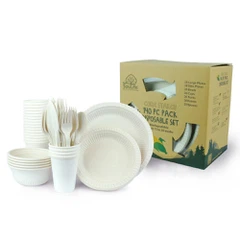
With the increasing popularity of take - out and food delivery services, PLA spoons are an ideal option. They can be included in Compostable Spoons and Forks sets and are often individually wrapped for hygiene. The Individually Wrapped Disposable Cutlery ensures that the spoons remain clean and ready to use when the food arrives at the customer's doorstep.
Conclusion and Call to Action
In conclusion, the hardness of a PLA spoon is a critical property that affects its functionality, durability, and user experience. At our company, we are committed to producing high - quality PLA spoons with the optimal hardness to meet the needs of our customers.
If you are in the food service industry, a distributor, or simply looking for eco - friendly disposable cutlery, we invite you to contact us for more information about our PLA spoons. We can provide samples for you to test the hardness and performance of our products firsthand. Let's work together to make a more sustainable choice for the environment without compromising on quality.
References
- "Plastics Science and Technology" by Charles A. Harper
- "Polymer Engineering and Science" journal articles on PLA properties
- ASTM standards for hardness testing of plastics
Send Inquiry