


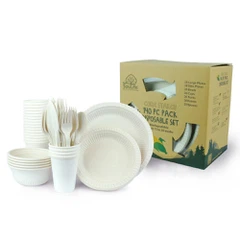
What is the production process of disposable cutlery kits?
Aug 11, 2025
Leave a message
Hey there! I'm a supplier of Cutlery Kits Disposable, and today I'm super excited to take you behind the scenes and show you what the production process of disposable cutlery kits is.
1. Raw Material Selection
The first step in making disposable cutlery kits is picking the right raw materials. Different types of cutlery kits need different materials.
For plastic cutlery, we usually go for polypropylene (PP) or polystyrene (PS). These plastics are great because they're cheap, lightweight, and can be easily molded into different shapes. They're also strong enough to handle normal use during a meal. You can check out our Plastic Cutlery with Napkin on our website.
If we're making compostable cutlery kits, we use materials like bamboo, sugarcane bagasse, or cornstarch. These are all natural and biodegradable, which is awesome for the environment. They break down easily in compost, leaving behind no harmful residues. Check out our Compostable Cutlery Kits to see what I'm talking about.
And when it comes to wooden cutlery, we source high - quality wood, usually birch or beech. These woods are durable and have a nice natural look. Our Disposable Wooden Cutlery Set is made from such great wood.
2. Material Preparation
Once we've got the raw materials, it's time to prepare them for production.
For plastics, the plastic pellets are first dried to get rid of any moisture. Moisture can mess up the molding process, so this step is crucial. After drying, the pellets are fed into an extruder. The extruder heats the pellets until they turn into a molten state, which can then be easily shaped.
When working with compostable materials like sugarcane bagasse, it's a bit different. First, the bagasse is cleaned to remove any impurities. Then it's mixed with water and other additives to form a pulp. This pulp is then ready to be molded into cutlery.


As for wood, the logs are first cut into smaller pieces and then planed to get a smooth surface. These smaller pieces are then cut into the basic shapes of the cutlery, like spoons, forks, and knives.
3. Molding
The molding process is where the magic happens. Different methods are used depending on the material.
In plastic cutlery production, injection molding is the most common method. The molten plastic is injected into a mold cavity under high pressure. The mold is designed to have the exact shape of the cutlery, like a fork or a spoon. Once the plastic cools and solidifies inside the mold, the mold opens, and the finished plastic cutlery comes out.
For compostable cutlery made from pulp, compression molding is used. The pulp is placed into a heated mold, and then pressure is applied. The heat and pressure help to remove the water from the pulp and shape it into the desired cutlery form.
Wooden cutlery goes through a machining process. After the basic shapes are cut, they're further refined using lathes and other wood - working tools to give them the final smooth and usable shape.
4. Finishing
After the cutlery is molded, it needs some finishing touches.
For plastic cutlery, any excess plastic or rough edges are trimmed off. Sometimes, a coating may be applied to make the cutlery look more shiny and smooth. This also helps to protect the plastic from scratches.
Compostable cutlery is also trimmed to remove any excess material. It may be sanded to make the surface smoother. And in some cases, a natural oil or wax can be applied to give it a nice finish and also make it more water - resistant.
Wooden cutlery is sanded multiple times to get a really smooth surface. This not only makes it more comfortable to hold but also removes any splinters. Then it may be treated with a food - safe finish to protect the wood and enhance its appearance.
5. Assembly of Kits
Once all the individual pieces of cutlery are finished, it's time to assemble them into kits.
A typical disposable cutlery kit may include a fork, a spoon, a knife, and sometimes a napkin. The cutlery pieces are carefully placed together in a packaging. For some kits, they may be wrapped in plastic film to keep them clean and hygienic.
The napkin, if included, is folded neatly and placed next to the cutlery. The packaging is then sealed, and a label is added with information like the brand name, the type of cutlery, and any safety instructions.
6. Quality Control
Quality control is a super important step in the production process.
We have a team of quality control experts who check every batch of cutlery kits. They look for any defects, like cracks in plastic cutlery, uneven surfaces on wooden cutlery, or any signs of contamination in compostable cutlery.
The cutlery is also tested for its strength and durability. For example, plastic forks are tested to see if they can hold food without breaking. Compostable cutlery is checked to make sure it meets the compostability standards.
Only after passing all these quality control tests are the cutlery kits ready to be shipped out to customers.
7. Packaging and Shipping
Once the cutlery kits pass the quality control, they're packaged for shipping.
The kits are usually packed in cartons. The cartons are labeled with details like the quantity of kits inside, the type of cutlery, and shipping instructions.
We work with reliable shipping partners to ensure that the cutlery kits are delivered to our customers in a timely and safe manner. Whether it's a local order or an international one, we make sure that the kits arrive in perfect condition.
Why Choose Our Disposable Cutlery Kits?
Our disposable cutlery kits are made with high - quality materials and strict production processes. We offer a wide range of options, from plastic to compostable and wooden cutlery. Our products are not only functional but also environmentally friendly in the case of compostable and wooden options.
If you're in the market for disposable cutlery kits for your restaurant, catering business, or any other event, we'd love to have a chat with you. We can offer you great prices and customized solutions to meet your specific needs. Don't hesitate to reach out to us and start a procurement discussion. We're here to make sure you get the best disposable cutlery kits for your requirements.
References
- "Plastic Injection Molding Handbook" by Ossa, Alexander
- "Woodworking Basics: From Log to Finished Product" by Johnson, Mark
- "Compostable Materials in Packaging and Disposable Products" by Green, Sarah
Send Inquiry