


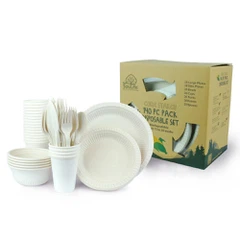
What is spork
Sep 15, 2026
Leave a message
What Is a Spork? 2-in-1 Spoon and Fork Design
Author: [2026-09-15] | By Xiamen Hocso Packaging Products Co., Ltd. Lana Zheng zhenglanlan@hocso.com
A spork is a hybrid eating utensil that combines a spoon-shaped bowl with short fork tines. Compared with a conventional fork, it offers better scooping performance; compared with a spoon, it provides limited piercing ability. For disposable foodservice, the choice between a fork and spork should be based on food texture, serving temperature, bowl depth, tine strength, material performance and packing requirements.
1. What Is a Fork? 3–4 Tines for Solid Food
A fork is designed primarily to pierce, lift, separate and hold solid or semi-solid food. Most eating forks have three or four tines, although the exact geometry varies according to the application.
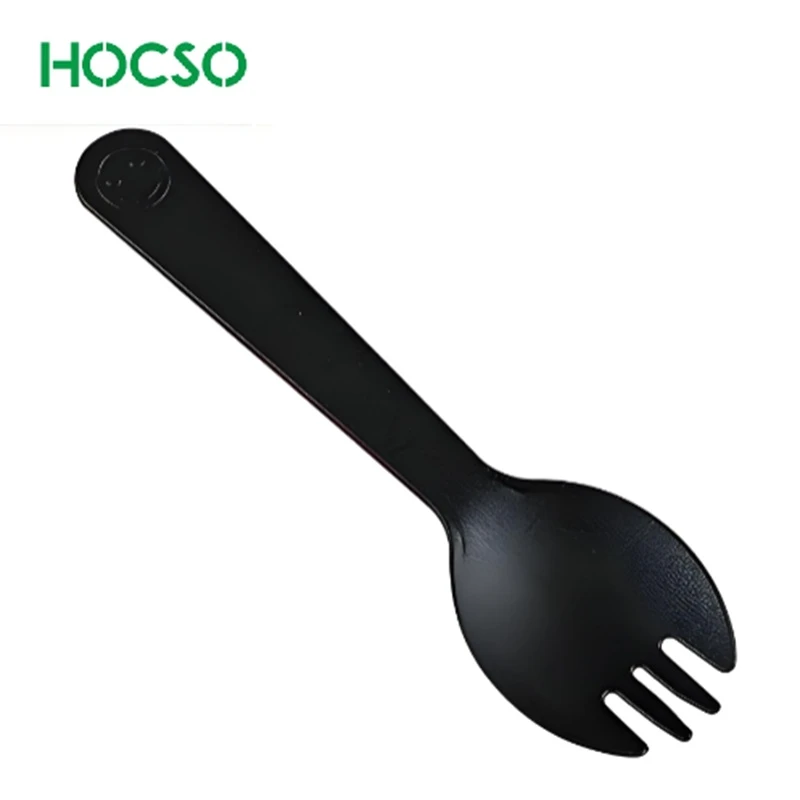
Fork Design and Food Contact Performance
A standard disposable fork normally consists of a handle, neck and tine section. The tine geometry determines how easily the utensil enters food and how much force the user can apply without bending or breaking it.
Forks are particularly suitable for:
- Meat pieces and grilled food requiring firm tine penetration.
- Pasta where the user needs to hold and separate strands.
- Salads containing vegetables and other solid ingredients.
- Fruit, bakery products and other relatively firm foods.
- Restaurant meals where conventional fork handling is expected.
For disposable foodservice, forks may be manufactured from PP, PS, CPLA, cornstarch-based compounds, bamboo or wood.
Fork Applications by Food Type and Temperature
| Application | Fork Suitability | Main Requirement |
|---|---|---|
| Salad | Excellent | Tine rigidity |
| Pasta | Excellent | Tine strength and handle control |
| Grilled meat | Excellent | Penetration strength |
| Fruit | Excellent | Sharp, smooth tine tips |
| Bakery food | Good | Tine geometry |
| Rice | Good | Depends on grain texture |
| Thick soup | Limited | Poor liquid retention |
| Clear soup | Poor | Spoon is more suitable |
A fork is therefore the better choice when piercing and holding performance matters more than liquid retention.
2. What Is a Spork? Shallow Bowl with Short Tines
A spork combines two functions in one utensil: the concave bowl of a spoon and the tines of a fork.
The bowl provides a surface for scooping rice, mashed potatoes, sauces and other soft foods. The short tines allow the user to pick up noodles, vegetables or other solid ingredients.
Spork Geometry for Mixed Meals
The design is a compromise.
A deeper spoon bowl can carry more liquid, but it leaves less room for long fork tines. Longer tines improve piercing performance but reduce the bowl area available for scooping.
This makes the geometry particularly important when a spork is developed for a specific meal format.
For example, a spork for a rice bowl may need a relatively broad bowl and moderate tine length, while a spork for noodles may require greater tine engagement and a longer handle.
Typical Spork Applications at 45–90°C
Sporks are commonly used for:
- Rice bowls
- Noodle dishes
- Pasta salads
- Grain bowls
- Mashed potatoes
- Desserts
- Beans
- Thick soups containing solid ingredients
- Takeaway meals
- School meal packs
- Catering meals
- Airline meal trays
- Camping and travel kits
A spork is less suitable for clear broth because its shallow bowl generally holds less liquid than a conventional soup spoon.
3. Fork vs Spork: Functional Differences at 45–90°C
The key difference is not appearance. It is how much scooping and piercing performance the utensil needs to provide at the same time.
| Feature | Fork | Spork |
|---|---|---|
| Primary function | Piercing and holding | Scooping plus light piercing |
| Bowl | No spoon bowl | Shallow spoon-like bowl |
| Tines | Usually longer | Usually shorter |
| Solid food | Excellent | Good |
| Soft food | Moderate | Excellent |
| Semi-liquid food | Poor | Good |
| Clear soup | Poor | Limited |
| Rice bowls | Good | Excellent |
| Noodles | Excellent | Good to excellent |
| Pasta salad | Good | Excellent |
| Portability | Requires another utensil for some meals | One utensil can perform two functions |
| Packing efficiency | Standard | Can reduce utensil count |
| Formal dining | Common | Less common |
| Takeaway | Common | Highly practical |
| School meals | Common | Highly practical |
| Travel meals | Good | Highly practical |
Fork or Spork: A Simple Foodservice Rule
Use a fork when the meal is predominantly solid and requires strong piercing or holding.
Use a spork when the meal contains both soft and solid components and one utensil needs to perform both functions.
Use a spoon when the meal is primarily liquid.
This simple distinction can prevent unnecessary utensil substitution and customer complaints.
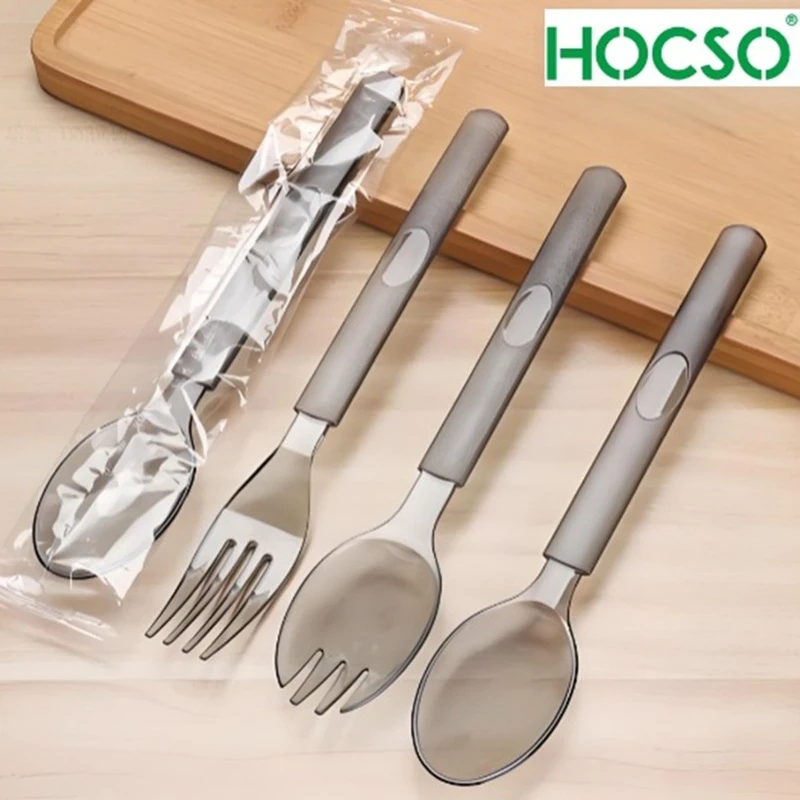
4. Spork Advantages: 2-in-1 Function and Lower Packing Volume
The main reason foodservice operators use sporks is simple: one utensil can cover two common eating functions.
Spork Benefits for Takeaway and Catering
- 2-in-1 function: One utensil can scoop soft food and pierce solid ingredients.
- Reduced utensil count: A spork can replace a separate fork and spoon for suitable meals.
- Compact meal packing: Fewer utensil pieces can simplify meal-kit assembly.
- Lower storage requirement: One SKU can cover mixed-food applications.
- Fast distribution: Useful for takeaway, catering and prepared-meal operations.
- Portable format: Suitable for travel, school meals, camping and outdoor catering.
For high-volume operations, the packing advantage can become significant.
Suppose a meal previously required one fork and one spoon. Replacing both with one suitable spork removes one utensil from each meal pack. Across 1 million meal packs, that represents 1 million fewer individual utensil pieces to purchase, store, count and pack.
The actual cost saving depends on product price, packaging configuration, labor and meal requirements, but the operational effect is easy to measure.
Request Disposable Spork Samples
5. Spork Materials: CPLA, PSM and Bamboo at 45–90°C
Material selection directly affects stiffness, heat resistance, breakage behavior, surface quality and end-of-life claims.
A spork that performs well at room temperature may behave differently when used with food served at 70–90°C.
Disposable Spork Material Comparison by Heat and Compliance
| Material | Typical Application | Heat Performance | Mechanical Behavior | Environmental Consideration |
|---|---|---|---|---|
| PP | Basic disposable foodservice | Product-specific | Good toughness | Conventional plastic |
| PS | Low-cost disposable applications | Lower heat tolerance than many PP grades | Rigid but relatively brittle | Conventional plastic |
| CPLA | Hot and cold foodservice | Commonly specified around 80–90°C, product dependent | High rigidity | Industrial compostability requires finished-product certification |
| Cornstarch-based compound | Takeaway and catering | Formulation dependent | Formulation and thickness dependent | Compostability depends on formulation and certification |
| Wood | Natural-look foodservice | Suitable for many warm foods | Rigid, but grain affects strength | Biobased; disposal depends on product and local system |
| Bamboo | Foodservice and natural-material applications | Suitable for many warm foods | Good strength-to-weight ratio | Renewable material; treatment and disposal route matter |
| Stainless steel | Reusable dining | High temperature tolerance | High durability | Reusable rather than disposable |
There is no universal "best" spork material.
A buyer should match the material to the actual food temperature, contact time, mechanical load, packaging requirement and disposal route.
6. CPLA Spork Performance: Crystallization and 80–90°C Service
CPLA stands for Crystallized Polylactic Acid. It is produced by modifying PLA through controlled crystallization to increase heat resistance and dimensional stability.
This makes CPLA particularly relevant for disposable sporks used with hot food.
Why CPLA Performs Differently From Conventional PLA
Conventional PLA can soften at relatively low temperatures. Crystallization changes the polymer morphology and increases resistance to thermal deformation.
For procurement purposes, do not approve a CPLA spork based only on the resin name.
The finished product should be evaluated for:
- Heat deformation
- Tine bending
- Handle flexural strength
- Bowl deformation
- Surface integrity
- Food-contact requirements
- Compostability certification where claimed
CPLA Spork Testing Parameters
| Test Item | Procurement Parameter |
|---|---|
| Product temperature exposure | Define actual food temperature |
| Thermal test range | Example: 60°C / 70°C / 80°C / 90°C |
| Exposure duration | Define according to intended use |
| Tine deformation | Record dimensional change |
| Handle deformation | Record permanent bending |
| Bowl deformation | Measure depth before and after test |
| Breakage | Record fracture or cracking |
| Food contact | Verify destination-market requirements |
| Compostability | Verify finished-product certification |
| Batch consistency | Compare production lots |
A supplier's "90°C heat resistant" statement has little value unless the test temperature, exposure time and acceptance criteria are also defined.

7. Cornstarch Spork Performance: Plant-Based Compound Selection
Cornstarch-based sporks are another option for disposable foodservice.
However, "cornstarch spork" does not describe one universal material formulation. Different manufacturers may use different polymer matrices, starch ratios, additives and processing conditions.
That means buyers should request the actual specification.
Cornstarch Spork Parameters for Factory Approval
- Material composition and grade
- Product weight in grams
- Overall length in millimeters
- Bowl depth in millimeters
- Tine length in millimeters
- Handle thickness
- Heat-use specification
- Food-contact documentation
- Compostability documentation where applicable
- Packaging configuration
- Carton quantity
- Gross weight
- Carton CBM
This is especially important for private-label programs because changing resin grade, mold geometry or product weight can change the finished utensil's mechanical performance.
8. Compostable Sporks: EN 13432 and ASTM D6400 Verification
A compostable claim should be treated as a finished-product compliance issue, not simply a material description.
For industrial compostability, buyers may encounter standards such as EN 13432 in Europe and ASTM D6400 in the United States.
Industrial Composting Conditions
Industrial composting typically involves controlled:
- Temperature
- Moisture
- Oxygen availability
- Microbial activity
- Processing time
CPLA and certain starch-based products can be designed for industrial composting, but the buyer should verify the certification scope of the actual finished spork.
A raw PLA resin certificate does not automatically prove that a finished molded spork meets a compostability standard.
Compostability Claims vs Disposal Reality
| Claim | What Buyers Should Verify |
|---|---|
| Biodegradable | Test method and degradation conditions |
| Compostable | Applicable finished-product requirements |
| Industrially compostable | Certification and facility conditions |
| Home compostable | Specific home-composting certification |
| PLA-based | Actual material composition |
| CPLA | Material grade and finished-product performance |
| Plastic-free | Exact product composition and applicable claim rules |
A compostable spork also needs a realistic disposal route. If the local waste system does not collect compostable foodservice products, the theoretical compostability of the material may not translate into the intended end-of-life result.
Request Spork Material & Compliance Documents
9. What Foods Are Sporks Good For? 45–90°C Application Guide
Sporks work particularly well when a meal contains several textures.
Rice Bowls at 60–80°C
Rice is easy to scoop, while vegetables, meat pieces and other ingredients may need light piercing. This is one of the clearest applications for a spork.
Noodles at 60–90°C
The fork tines help gather noodles, while the bowl can catch sauce and smaller ingredients.
Pasta Salad at 5–25°C
The combination of pasta, vegetables, dressing and other ingredients makes a spork practical for cold prepared meals.
Desserts at 5–25°C
Soft cakes, pudding, fruit and other desserts can be handled without needing separate spoon and fork functions.
Thick Soup at 60–90°C
A spork can work when the soup contains noodles, vegetables, rice or meat. For clear broth, a deep spoon remains the better tool.
Food Application Matrix
| Food | Typical Serving Temperature | Fork | Spork | Spoon |
|---|---|---|---|---|
| Salad | 5–15°C | Excellent | Excellent | Limited |
| Rice bowl | 50–80°C | Good | Excellent | Good |
| Noodles | 50–90°C | Excellent | Excellent | Good |
| Pasta salad | 5–25°C | Good | Excellent | Good |
| Mashed potatoes | 50–70°C | Limited | Excellent | Excellent |
| Dessert | 5–25°C | Good | Excellent | Excellent |
| Thick soup with ingredients | 60–90°C | Limited | Good | Excellent |
| Clear broth | 60–90°C | Poor | Limited | Excellent |
| Grilled meat | 60–80°C | Excellent | Good | Poor |
10. When Not to Use a Spork: 90°C Heat and Liquid Handling Limits
A spork is not a universal replacement for every utensil.
Clear Soup: Use a Deep Spoon
The shallow bowl of a spork normally carries less liquid than a soup spoon. Users may need more scoops, increasing inconvenience and spill risk.
Hard Meat: Use a Fork and Knife
Short spork tines are not intended to replace a knife when cutting dense meat.
Formal Dining: Use Conventional Flatware
A standard fork provides more familiar handling and better piercing control for formal restaurant service.
Deep Containers: Check Handle Length
A short spork can become uncomfortable when the food container is deep. The handle should be evaluated against the actual cup, bowl or tray depth.
High-Temperature Food: Verify the Material
Never assume that all disposable or compostable sporks have the same heat resistance.
For a meal served at 85°C, for example, a product rated only for 45°C should not be approved simply because both products are marketed as "biodegradable."
11. Spork Manufacturing: Mold Geometry, Weight and Dimensional Control
For a disposable spork manufacturer, product performance begins with mold design.
Small geometry changes can affect:
- Resin consumption
- Product weight
- Tine rigidity
- Bowl stiffness
- Handle flex
- Cooling time
- Cycle time
- Warpage
- Ejection performance
Injection-Molded Spork Control Points
For polymer-based products such as CPLA and selected starch compounds, process engineers should control:
- Material drying and moisture content where required.
- Melt temperature according to the selected material grade.
- Injection pressure and filling speed.
- Mold temperature.
- Cooling time.
- Gate position.
- Ejection force.
- Product warpage.
- Tine dimensions.
- Finished-product weight.
Excessive moisture or unsuitable processing conditions can affect surface quality and dimensional stability.
For high-volume orders, piece weight is also a cost parameter. A difference of only 0.5 g per utensil becomes 500 kg of material across 1 million pieces.
That is why product weight should be locked during sample approval.
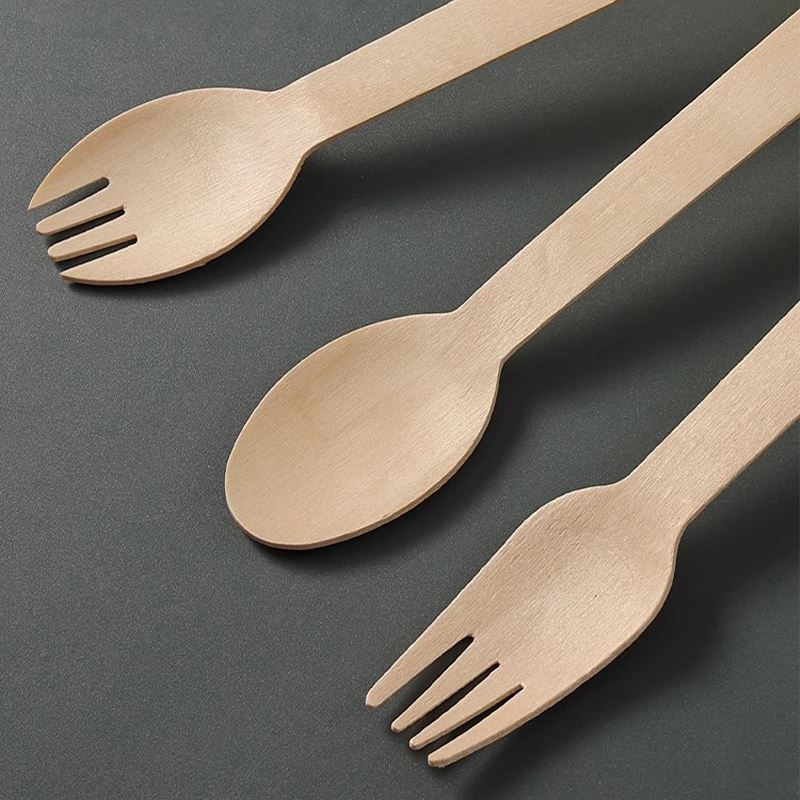
12. Spork Packaging: Individual Wrapping, Sets and Carton CBM
For large foodservice programs, the utensil itself is only part of the specification.
Packaging can include:
- Bulk-packed sporks
- Individually wrapped sporks
- Spork plus napkin
- Spork, fork and spoon sets
- Kraft-paper packs
- Printed sleeves
- Custom meal kits
Packaging Parameters for Wholesale Orders
| Parameter | Example Specification |
|---|---|
| Packing method | Bulk / individual / set |
| Sporks per inner bag | Buyer specified |
| Inner bags per carton | Buyer specified |
| Pieces per carton | Buyer specified |
| Carton dimensions | L × W × H |
| Gross weight | kg |
| Net weight | kg |
| Carton volume | CBM |
| Pallet quantity | Cartons/pallet |
| Container loading | Pieces or cartons/container |
For international shipments, buyers should compare pieces per CBM rather than looking only at unit price.
A slightly more expensive spork may produce a lower delivered cost if its packaging occupies less container volume.
13. Quality Inspection: AQL 2.5 and Food-Contact Control
A disposable spork should be inspected at both the component and finished-product level.
Dimensional Inspection
Check:
- Overall length
- Handle width
- Bowl width
- Bowl depth
- Tine length
- Tine spacing
- Product weight
Mechanical Inspection
Check:
- Tine bending
- Tine breakage
- Handle flex
- Bowl deformation
- Cracking
- Edge condition
Appearance Inspection
Check for:
- Flash
- Short shots
- Black spots
- Flow marks
- Warpage
- Surface contamination
- Color variation
- Sharp edges
AQL 2.5 Production Inspection
An AQL 2.5 sampling plan can be included in the agreed pre-shipment inspection specification. The buyer and supplier should define the sampling level and defect classification before mass production.
For food-contact products, critical defects should be treated separately from cosmetic defects.
14. China Spork Manufacturer: What International Buyers Should Verify
When selecting a spork supplier or factory in China, price should not be the only qualification factor.
A serious factory audit should examine:
- Production capacity
- Raw-material traceability
- Material storage
- Moisture control
- Mold management
- Injection-process control
- Product-weight consistency
- Food-contact documentation
- Compostability documentation where applicable
- Packaging inspection
- Batch traceability
- Final inspection
- Export experience
- Private-label capability
Xiamen Hocso Packaging Products Co., Ltd. was established in 2014 in Xiamen, Fujian, China. The company reports more than 200 employees, a 10,000 m² production area, and production capacity of approximately 1 million disposable cutlery sets per day.
HOCSO manufactures disposable cutlery sets, disposable chopsticks, napkins, toothpicks and related foodservice products. The company reports ISO 22000 and HACCP certification since 2014, together with ISO 9001 quality-system certification and more than 400 model patents.
For importers, restaurant groups and distributors, the practical audit question is simple:
Can the factory reproduce the approved spork specification at production scale?
That means controlling material, weight, dimensions, mechanical performance, packaging and documentation from sample approval through repeat orders.
15. Spork Selection Checklist: 10 Parameters for Procurement Approval
Before approving a disposable spork, procurement and QA teams should confirm:
- Food type and texture are defined.
- Operating temperature is defined, such as 25°C, 60°C or 85°C.
- Overall spork dimensions are approved.
- Bowl depth is suitable for the meal.
- Tine geometry and strength are tested.
- Handle length matches the food container.
- Material grade is specified.
- Food-contact documentation is available.
- Compostability certification matches the finished product where required.
- Packaging, MOQ, carton CBM and production lead time are confirmed.
This specification-based approach is more reliable than selecting a spork from a catalog based only on appearance or unit price.
16. Spork vs Fork: The Procurement Decision at a Glance
| Buyer Requirement | Better Choice |
|---|---|
| Mainly solid food | Fork |
| Strong piercing performance | Fork |
| Formal restaurant service | Fork |
| Rice bowl | Spork |
| Mixed noodles and vegetables | Spork |
| Pasta salad | Spork |
| Dessert meal kit | Spork |
| Thick soup with ingredients | Spork |
| Clear soup | Spoon |
| One utensil for mixed meals | Spork |
| Compact takeaway pack | Spork |
| Lowest number of utensil pieces | Spork |
| High-temperature meal | Material-dependent; verify specification |
| Certified compostable requirement | Certified CPLA / approved material, subject to market requirements |
Discuss Your Spork Specification
17. What Is a Spork? Final Engineering Summary
A spork is a spoon-fork hybrid designed for mixed foods. Its shallow bowl provides scooping ability, while its short tines provide limited piercing performance.
For foodservice buyers, the decision is straightforward:
Choose a fork for stronger piercing. Choose a spork for mixed meals. Choose a spoon for liquid-heavy foods.
Material selection comes next. CPLA can provide higher heat resistance than conventional PLA, while cornstarch-based compounds, bamboo, wood, PP and other materials each have different operating characteristics. The final choice should be based on the actual temperature, food texture, mechanical load, food-contact requirements and disposal route.
For high-volume procurement, also evaluate piece weight, dimensional tolerance, packaging configuration, carton CBM, MOQ, production capacity and inspection criteria.
HOCSO supplies disposable sporks and other disposable cutlery formats for restaurants, catering companies, takeaway brands, schools, airlines, distributors and importers. Product selection can be based on material, food application, temperature, packaging format and destination-market documentation.
FAQ: Spork Specification and Wholesale Purchasing
What is the main difference between a fork and a spork for foodservice?
A fork is optimized for piercing and holding solid food. A spork combines a shallow spoon bowl with short tines, making it better for mixed meals such as rice bowls, noodles, pasta salads and thick soups.
Can a CPLA spork be used with food at 85°C?
Some CPLA sporks are designed for temperatures around 80–90°C, but performance is product-specific. Buyers should verify the finished utensil's heat-resistance test, exposure time, material grade and dimensional stability before approval.
Can HOCSO manufacture custom sporks for restaurant chains?
Yes. HOCSO can support disposable cutlery development and private-label production, including product specifications, packaging configuration and custom cutlery sets. MOQ and lead time depend on the product design, tooling and packaging requirements.
Discuss Your Spork Specification
Send Inquiry