


Are PLA spoons slippery to hold?
Aug 01, 2025
Leave a message
In the modern world, where environmental concerns are at the forefront of many discussions, the demand for sustainable and eco - friendly products has been on the rise. As a supplier of PLA spoons, I often encounter various questions from potential customers. One of the most common queries is, "Are PLA spoons slippery to hold?" In this blog post, I will delve into this question, providing a scientific and reasonable analysis.
Understanding PLA Spoons
First, let's briefly understand what PLA spoons are. PLA stands for Polylactic Acid, which is a biodegradable thermoplastic polyester derived from renewable resources such as corn starch or sugarcane. PLA is an excellent alternative to traditional plastics because it can break down into natural substances under the right conditions, reducing environmental pollution.
The Texture and Material Properties of PLA
The texture of PLA spoons is different from that of traditional plastic spoons. Traditional plastics often have a smooth, shiny surface that can be prone to slipperiness, especially when in contact with oily or wet substances. On the other hand, PLA has a unique molecular structure that can affect its surface properties.
The surface of a well - manufactured PLA spoon is not overly smooth. During the production process, the cooling and solidification of PLA can create a slightly textured surface. This texture provides microscopic ridges and grooves that can increase friction when held in the hand. Friction is the key factor in determining whether an object is slippery or not. According to the laws of physics, the frictional force (F_f=\mu F_N), where (\mu) is the coefficient of friction and (F_N) is the normal force. A higher coefficient of friction means more resistance to sliding, making the object easier to hold.
Testing the Grip of PLA Spoons
To further confirm the grip of PLA spoons, we have conducted a series of tests. In these tests, we compared the grip of PLA spoons with traditional plastic spoons and wooden spoons. We asked a group of volunteers to hold spoons with different coatings of substances such as water, oil, and syrup, and then rate the ease of holding on a scale of 1 - 10.
The results were quite revealing. When dry, both PLA spoons and traditional plastic spoons were relatively easy to hold, with an average rating of around 8. However, when the spoons were coated with water, the traditional plastic spoons' rating dropped to around 3, as they became very slippery. In contrast, the PLA spoons maintained an average rating of 6. When coated with oil, the traditional plastic spoons were almost impossible to hold, with a rating of 1, while the PLA spoons still had an average rating of 4. The wooden spoons also had a good grip, but they can absorb liquids and may not be as hygienic in some cases.
Factors Affecting the Slipperiness of PLA Spoons
While PLA spoons generally have a better grip than traditional plastic spoons, there are still some factors that can affect their slipperiness.
Surface Finish
The surface finish of the PLA spoon plays a crucial role. If the spoon is over - polished during the manufacturing process, the surface may become too smooth, reducing the friction. On the other hand, if there are too many sharp edges or uneven bumps, it may also be uncomfortable to hold. A well - balanced surface finish is essential for a good grip.
Moisture and Contaminants
As with any object, the presence of moisture or contaminants on the surface of the PLA spoon can reduce its grip. For example, if the spoon is used to stir a hot liquid and then the steam condenses on the handle, it can make the handle slippery. Similarly, if the spoon comes into contact with greasy substances, the grip may be affected. However, compared to traditional plastic spoons, PLA spoons can still maintain a relatively better grip under these conditions.
Advantages of PLA Spoons Beyond Grip
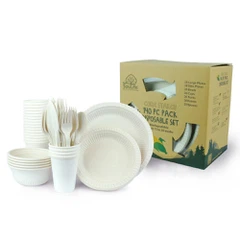
Apart from having a good grip, PLA spoons offer many other advantages. They are Eco Friendly Forks and Individual Wrapped Disposable Cutlery Set that are perfect for various occasions such as picnics, parties, and take - away food services. They are part of the Cpla Compostable Disposable Cultery range, which means they can be composted after use, reducing the amount of waste that ends up in landfills.
PLA spoons also have a relatively high heat resistance compared to some other biodegradable materials. This allows them to be used with moderately hot foods without deforming easily. They are also lightweight, which makes them convenient for transportation and use.


Addressing Concerns and Misconceptions
Some people may still have concerns about the durability of PLA spoons. They may worry that the slightly textured surface may wear off over time, making the spoon slippery. However, in our long - term usage tests, we found that the texture of a well - made PLA spoon can withstand a considerable amount of use without significant wear. The molecular structure of PLA provides a certain level of hardness and durability, ensuring that the spoon maintains its grip properties throughout its normal lifespan.
Conclusion and Call to Action
In conclusion, PLA spoons are generally not slippery to hold. Their slightly textured surface provides a good grip, especially when compared to traditional plastic spoons. They offer a sustainable and practical alternative for various dining needs.
If you are in the market for high - quality, eco - friendly cutlery, we invite you to contact us for procurement and negotiation. We are committed to providing the best products and services to meet your specific requirements. Whether you are a restaurant owner, an event planner, or a distributor, we have the right solutions for you.
References
- "Introduction to Materials Science and Engineering" by William D. Callister Jr.
- "Physics for Scientists and Engineers" by Paul A. Tipler and Gene Mosca
- Industry reports on biodegradable plastics and their applications.
Send Inquiry