


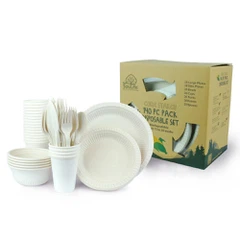
Do disposable utensils sets dissolve in water?
Sep 25, 2025
Leave a message
Do disposable utensils sets dissolve in water? That's a question I've been asked a bunch of times as a supplier of Disposable Utensils Set. And it's a fair one, especially these days when folks are more conscious about the environment and how products break down.
Let's start by looking at the different types of disposable utensils out there. There are mainly two big categories: plastic and bamboo. Each has its own characteristics when it comes to water resistance and dissolution.
Plastic Disposable Utensils
Plastic cutlery is super common. You see it everywhere - at fast - food joints, picnics, and office parties. It's cheap, lightweight, and easy to mass - produce. But the big question is, does it dissolve in water?
Well, most plastics used in Plastic Cutlery Set Individually Wrapped are made from polymers like polypropylene or polystyrene. These polymers are hydrophobic, which means they don't like water. In simple terms, they won't dissolve in water under normal conditions.
If you toss a plastic fork or spoon into a glass of water, it'll just sit there. The water molecules can't break apart the long - chain polymer molecules that make up the plastic. It's like trying to dissolve a brick in water - it's just not going to happen.
However, it's important to note that just because plastic utensils don't dissolve in water doesn't mean they're harmless to the environment. Plastic can take hundreds of years to break down in the environment. It often ends up in landfills or, worse, in our oceans, where it can harm marine life. Some sea animals mistake small plastic pieces for food, which can lead to health problems and even death.
Bamboo Disposable Utensils
Now, let's talk about Disposable Bamboo Cutlery Set. Bamboo is a natural material, and it behaves quite differently from plastic. Bamboo is made up of cellulose, hemicellulose, and lignin. These components are more hydrophilic than plastic polymers, meaning they have a better relationship with water.
But here's the thing: bamboo utensils don't dissolve in water either. When you put a bamboo fork or spoon in water, it might absorb some water and become a bit softer over time. This is because the water molecules can penetrate the structure of the bamboo and interact with its components. But it won't dissolve completely.
The reason is that the lignin in bamboo acts like a glue that holds the cellulose fibers together. Even when exposed to water, the lignin provides enough structural integrity to prevent the bamboo from falling apart. However, if you leave a bamboo utensil in water for a really long time, say weeks or months, the water can start to break down the lignin and cellulose, and the utensil will eventually start to decompose.
Factors Affecting Dissolution
There are a few factors that can influence whether a disposable utensil might seem to "dissolve" or break down in water.
Temperature: Higher temperatures can speed up chemical reactions. If you put a plastic or bamboo utensil in hot water, the molecules will be more active. For plastic, it might start to warp or deform at high temperatures, but still, it won't dissolve. For bamboo, hot water can accelerate the absorption process and make the utensil softer faster.
pH Level: The acidity or alkalinity of the water can also play a role. If the water is highly acidic or alkaline, it can react with the materials of the utensils. For example, strong acids can react with the polymers in plastic over a long period, but it's not a dissolution in the traditional sense. In the case of bamboo, extreme pH levels can break down the components more quickly.
Duration of Exposure: The longer a utensil is in water, the more likely it is to show signs of change. As mentioned earlier, a short - term dip in water won't do much to either plastic or bamboo utensils. But long - term exposure can lead to degradation, especially for bamboo.
Why This Matters for My Business
As a supplier of disposable utensils, understanding whether these products dissolve in water is crucial. It helps me answer my customers' questions and also guides me in promoting the right products.
For customers who are worried about the environment, I can recommend Disposable Bamboo Cutlery Set. While it doesn't dissolve in water, it's a more sustainable option compared to plastic. Bamboo is a renewable resource, and it decomposes much faster in the environment.
On the other hand, Plastic Cutlery Set Individually Wrapped still has its place in the market. It's more affordable and has a longer shelf - life. But I always make sure to inform my customers about the environmental impact of plastic.


Conclusion
In conclusion, neither plastic nor bamboo disposable utensils dissolve in water under normal conditions. Plastic utensils are hydrophobic and won't break down in water, but they pose a long - term environmental threat. Bamboo utensils, while more sustainable, also don't dissolve but can decompose over a long period when exposed to water.
If you're in the market for disposable utensils, whether it's for a small gathering or a large event, I'd love to have a chat with you. We can discuss your needs and find the best solution for you. Whether you're leaning towards the affordability of plastic or the sustainability of bamboo, I've got you covered. Reach out to me, and let's start the conversation about your next utensil purchase.
References
- "Introduction to Polymers" by Young and Lovell
- "Wood Chemistry: Fundamentals and Applications" by Hon and Shiraishi
Send Inquiry