


Is disposable cpla cutlery eco - friendly?
Jan 12, 2026
Leave a message
Hey there! As a supplier of disposable CPLA cutlery, I often get asked, "Is disposable CPLA cutlery eco - friendly?" Well, let's dive right into it and find out.


First off, let's talk about what CPLA is. CPLA stands for Crystallized Poly Lactic Acid. It's a type of bioplastic made from renewable resources, usually corn starch or sugarcane. Unlike traditional plastics that are derived from fossil fuels, CPLA has a much lower carbon footprint from the get - go. The raw materials used to make CPLA are plants, which absorb carbon dioxide during their growth. So, right at the production stage, CPLA is already looking like a more sustainable option.
One of the biggest advantages of CPLA cutlery is its compostability. When disposed of in a commercial composting facility, CPLA cutlery can break down into natural substances like water, carbon dioxide, and biomass within a relatively short period. This is a far cry from traditional plastic cutlery, which can take hundreds of years to decompose and often ends up in landfills or our oceans, causing significant environmental damage.
Now, I know what you're thinking. "But what about home composting?" Well, here's the deal. CPLA cutlery requires specific conditions to break down efficiently, and most home compost setups don't provide those ideal conditions. Commercial composting facilities have the right temperature, humidity, and microbial activity to speed up the decomposition process. So, while it might not be the best fit for home composting, it's still a great option for a larger - scale, more controlled composting environment.
Another aspect to consider is the energy consumption during production. Manufacturing CPLA cutlery generally uses less energy compared to making traditional plastic cutlery. The process of extracting and refining fossil fuels for plastic production is energy - intensive. On the other hand, the production of CPLA involves processing renewable plant materials, which is a more energy - efficient process. This means that not only is CPLA better for the environment in terms of disposal, but it's also more sustainable during the manufacturing phase.
But it's not all sunshine and rainbows. There are some challenges associated with CPLA cutlery. For example, the cost of producing CPLA cutlery is often higher than that of traditional plastic cutlery. This is mainly due to the relatively new technology and the cost of sourcing renewable raw materials. However, as the demand for eco - friendly products increases and production processes become more efficient, we can expect the cost to come down over time.
Also, there's a bit of confusion in the market about what "compostable" really means. Some consumers might assume that CPLA cutlery can be thrown into their backyard compost pile and will disappear quickly. As I mentioned earlier, that's not the case. There needs to be more education about the proper disposal methods for CPLA cutlery to ensure that its environmental benefits are fully realized.
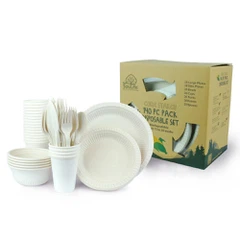
Now, let's talk about the practical side of using CPLA cutlery. In terms of performance, CPLA cutlery is quite comparable to traditional plastic cutlery. It's sturdy enough to handle most types of food, whether it's a light salad or a hearty steak. And it comes in a variety of styles and designs to suit different needs. If you're in the market for some high - quality CPLA cutlery, check out our Wrapped Disposable Silverware and Individually Wrapped Disposable Cutlery. These options are not only convenient but also look great at any event.
We also offer Cpla Compostable Disposable Cultery, which is perfect for those who are really committed to reducing their environmental impact. Our cutlery is made with high - grade CPLA material to ensure durability and functionality.
So, is disposable CPLA cutlery eco - friendly? In my opinion, the answer is a resounding yes. While it has its limitations, the overall environmental benefits far outweigh the drawbacks. It's a step in the right direction towards a more sustainable future.
If you're a business owner, event planner, or just someone who wants to make more eco - friendly choices, I encourage you to consider switching to CPLA cutlery. It's a small change that can make a big difference. And if you're interested in purchasing our disposable CPLA cutlery, feel free to reach out to us for more information and to discuss your specific needs. We're here to help you make the transition to a more sustainable option.
References
- European Bioplastics. (2023). Bioplastics Market Data.
- United Nations Environment Programme. (2022). Marine Litter and Microplastics: Global Lessons and Research to Inspire Action and Guide Policy Change.
Send Inquiry