


Takeout Cutlery Guide: Save Costs, Keep Customers Happy
Jul 11, 2025
Leave a message
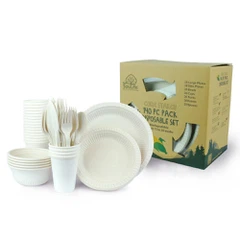
In the fierce competition of the takeout industry, disposable cutlery sets-often overlooked as a "minor detail"-directly impact customer experience and repeat orders. Many restaurant owners face a dilemma: choosing cheap cutlery risks customer complaints about poor quality, while premium options may exceed budget limits. This article breaks down the cost control, user experience optimization, and eco-friendly trends to help you find the perfect balance.

Crack the Cost Code: Hidden Savings in Disposable Cutlery Sets
1.1 Material Selection: Avoid Being "Held Hostage" by "Eco-Friendly" Labels
| Material Type | Price Range (USD per set) | Pros & Cons | Target Users |
|---|---|---|---|
| Traditional Plastic | 0.015–0.045 | Low cost, but prone to customer complaints about "non-eco-friendly"; faces policy risks (e.g., plastic bans in some cities) | Budget-limited restaurants |
| Starch-Based | 0.045–0.075 | Partially degradable, balances cost and eco-friendliness; suitable for basic environmental needs | Small/medium restaurants with budget constraints |
| PLA | 0.075–0.12 | Requires industrial composting (50–60°C, high humidity); ideal for premium brands or eco-themed restaurants | High-end restaurants, eco-conscious brands |
| Bamboo Fiber | 0.12–0.18 | Naturally degradable, no plastic coating; fits health/natural food stores | Light meal shops, organic restaurants |
Recommendation:
Small/medium restaurants: Prioritize starch-based disposable cutlery sets (cost-effective + basic eco-friendliness).
Premium brands: Upgrade to PLA or bamboo fiber sets to align with sustainability trends.
1.2 Specification Optimization: Eliminate "Over-Packaging" Waste
Solo Meal: 1 pair of chopsticks + 1 spoon + 1 napkin (cost: ~$0.06)
Soups/Stews: Add 1 straw + 1 fork (extra cost: $0.03)
Group Orders: Configure based on diners (e.g., 4 people = 4 chopstick pairs + 4 spoons), avoiding "one set for all" waste.
Case Study:
A Sichuan restaurant reduced monthly packaging costs by $225 by switching from "fixed three-piece sets" to "meal-specific configurations."
1.3 Bulk Procurement: Leverage "Economy of Scale" for Discounts
<1,000 sets: No discount
5,000–10,000 sets: 10–15% price reduction
10,000 sets: Up to 20% savings
Boost Satisfaction: Unspoken Needs Customers Won't Tell You
Customers may not explicitly say "I hate this spoon," but a poor experience will drive them away. Focus on these practicality, eco-perception, and surprise factors to turn cutlery into a brand asset.

2.1 Practicality > Aesthetics: Solve "Hard-to-Use" Pain Points
Chopsticks: Choose rounded, anti-slip designs (cost: +$0.008 per pair) to avoid splinters or slippage.
Spoons: Opt for deep bowls (≥2cm depth) with thickened edges to prevent spills and scalding.
Napkins: Use large sizes (18cm×20cm+) and print your brand slogan (cost: +$0.003 per sheet).
2.2 Eco-Friendly Storytelling: Make Customers "See" Your Efforts
Data: 72% of consumers will pay 0.15–0.30 extra for eco-friendly cutlery (Meituan Research, 2023).
Tactics:
Print: "This set uses starch-based material-compostable in 6 months!" on packaging.
Add a small card: "Dispose in wet waste. Thank you for protecting the planet!"
Include certifications: OK Compost (EU) or BPI (US) labels (cost: +$0.004 per set).
2.3 Surprise Factor: Low-Cost Creative Touches
Branded Details: Engrave your logo on chopstick ends ($0.008 extra per pair) or add fun slogans on spoon handles ("This spoon warms your heart and soup!").
Seed Paper: Include a biodegradable card that grows herbs (cost: $0.015 per sheet).
Case Study:
A bubble tea shop printed "love quotes" on straw sleeves, driving a 30% surge in social media shares and a 15% order increase.
Pitfalls to Avoid: Common Mistakes That Turn 5-Star Reviews into 1-Star Rants

3.1 Mixed Materials: A Recycling Nightmare
Error: Mixing PLA and traditional plastic cutlery in one order.
Solution: Use uniform materials or clearly label "degradable" vs. "non-degradable" zones.
3.2 Scene Neglect: "One Size Fits All" Fails
Error: Providing forks but no spoons for salad orders.
Solution: Match cutlery to dishes (e.g., pizza = knife/fork; congee = deep spoon).
3.3 Over-Packaging: Wasteful Designs That Harm the Planet and Profits
Error: Using oversized boxes or multiple plastic bags.
Solution: Adopt minimalist, foldable designs (50% space reduction) or reusable packaging (e.g., cloth bags for group orders).
Quick Action Guide: 3 Steps to the Perfect Disposable Cutlery Set

Budget Calculation: Allocate 3–5% of dish pricing to cutlery (e.g., a 5dish=0.15–$0.25 for cutlery).
User Testing: Buy 3–5 samples and have loyal customers rate usability.
Policy Alignment: Check local eco-regulations (e.g., EU's Single-Use Plastics Directive) and stock up on degradable options in advance.
Final Tip: Cutlery Is Your Only "Physical Touchpoint"
In the takeout scene, disposable cutlery sets are the sole tangible interaction with customers. Nail this detail to convey brand warmth; get it wrong, and customers will walk away. Instead of overspending on delivery platform ads, invest $0.05 more per set to turn a "necessary evil" into a loyalty-building tool.
Share Your Story: What's the weirdest takeout cutlery set you've encountered? A funny design or an eco-fail? Comment below-the top story wins a free sample of our "seed paper cutlery set"!
Send Inquiry